
Lessons from The Godfather
My fourth book on Health Care to be published in May

“Just when I thought I was out they pull me back in.”
Michael Corleone, The Godfather
My many decades relationship with health care began as a child following my surgeon father Percy around hospitals in Winnipeg on Saturday mornings. He would visit all of his post-surgical patients, and I would learn about health care at their bedside.
Since those early days I’ve had many roles in health care including consulting, writing, speaking, chairing many health boards and a stint as Ontario’s Deputy Minister of Health. Other interests have lured me including over three decades and counting in the investment world. But health care always pulls me back in.
I confess I love writing almost as much as I like reading. And I’m delighted to announce that a fourth book on health/health care – my twelfth published book overall – will be published by Sutherland House Books on May 5, 2026.

It’s available for pre-order now! From your favourite independent, Indigo, Amazon or wherever you buy books in Canada and the US.
The Canadian Health Care Guerrilla Handbook: How to Fight for What You Need is designed to arm Canadians with the strategies, stories, and tactics to fight for the care you and your loved ones need. The book reveals how patients have taken on the system and won: from the largest class-action settlement in Canadian history to securing life-saving drugs for rare diseases.
It’s not a book about health policy, which I’ve written about at length in the past. But rather my co-author Mike McCarthy and I were determined to create a survival manual that explains how the system works and step-by-step tools to navigate it. Though we do include a few recommendations for policymakers and a resource guide.
Mike’s full story, in his own words, is in our book. But let me tell you some important things about him here.
First, Mike is a hero of mine. He’s a leader who has survived a lifetime with a serious heredity medical condition, hemophilia. Affected personally by the tainted blood scandal – he was one of the 30,000 people infected with Hepatis C between 1980 and 1990 – Mike led the fight for justice for other victims including the 2,000 Canadians who contracted HIV.
Ultimately the Krever Enquiry, a landmark Canadian commission, would determine this was a largely preventable tragedy caused by a dysfunctional system.
Mike’s fight led to a $2.1 billion dollar settlement of a class action lawsuit. It also led to the removal of the Canadian Red Cross from the blood system as they’d failed in their duty to protect those receiving blood. Mike never blinked through the long and contested battle.
He went on, with his consulting partner Francesca Grosso to found the firm Grosso McCarthy and to spend the last three decades fighting for improvements in Canadian health care. For children with cystic fibrosis, for example, advocacy led to access to a new and successful drug.
My own writing journey began just after my time as Deputy Minister of Health in Ontario. The University of Toronto offered me a place to work by appointing me as a Senior Research Scholar at the Institute for Bioethics. Rob Prichard, then President of the University, was in large measure responsible for my appointment. I was grateful to him then, and I still am.
The Institute was housed in a former church and my office was the top floor. Or as I viewed it, the attic. The Institute was located only a block south of my deputy minister office at the Hepburn block at Queens Park. But all similarities ended with location.
As one might imagine, the deputy minister’s office at health was a very busy place. In fact, my memory is there were eight or ten telephone lines that lit up continually. And staff to answer them.
When I moved to my Bioethics Institute attic to write, there was a dial phone in the attic that never rang. A humbling experience! Any illusion that calls to the ministry were to me gave away to the more accurate realization that they were to whoever held that office.
I worked away on my first book Healing Medicare, Managing Health System Change The Canadian Way (published in 1994) but every few hours I would walk across the room and lift the telephone just to see that there was a dial tone.
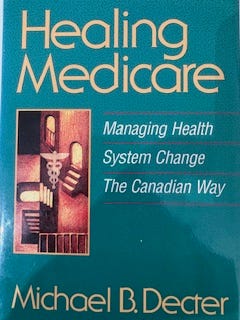
One astute reader of the book described it as ‘grief writing.’ She said I had written about all the things I didn’t get done when I was Deputy Minister.
There was a measure of truth in that although I’ve come to understand that change in Canadian healthcare is a very slow process. The many interest groups are powerful, and there’s an almost irresistible political force that bends towards a status quo with ever more funding.
The alternative of innovation does happen but at a glacial pace and often resisted by many players – those who already get the lions share of money.
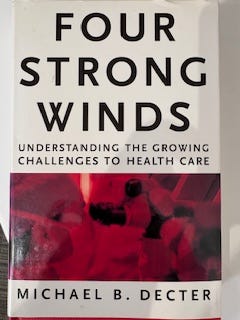
My next health book, Four Strong Winds, Understanding The Growing Challenges To Health Care was published by Stoddart Publishing in 2000.
This book had an interesting origin. Over the years, I had received many invitations to speak at health conferences. When attending, I made a practice of listening to other lectures on “forces” shaping health care.
As Deputy Minister, I was at the centre of the health hurricane on a daily basis. I was curious and over a period of a couple years, my own thoughts became clearer and more focused. Between my own experience, and that which I learned from others, I boiled down what I learned to four forces:
Powerful New Ideas
New Public Expectations Speed, Quality and Appropriateness
Technology Chip Driven Change
Fiscal Constraints; The Big Squeeze
As a fan of Ian and Sylvia Tyson’s music, the title came to mind and fit well with the book’s themes.
When Four Strong Winds was published, it led to many more speaking engagements both in Canada and internationally. Over the following two years, I gave fifty or sixty speeches, where I spoke about these forces and illustrated them with stories and examples.
I enjoyed meeting people across countries and discipline and sharing views about health and healthcare. Four Strong Winds also was adopted by a number of colleges on student course reading lists. This gave it a decade of steady sales.
In 2006 Francesca Grosso and I published Navigating Canada’s Health Care A User Guide to Getting the Care You Need with Penguin Canada.
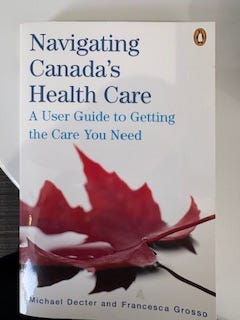
Our hope was it Navigating would assist many Canadians in finding the care they needed within the complexities of Canada healthcare services. We avoided the word ‘system’ despite people’s propensity to call it that.
Because, based on our work and experience, it was clear to us that Canada was not integrated to the point of truly being a system.
Government had agreed to pay for many health services, primarily physician and hospital care. Over decades they had also added varying amounts of coverage for drugs and other health services. What we found lacking and tried to address was how Canadians seeking care could find their way to the right healthcare service.
Francesca did an enormous amount of work on the detail of the book and that more than anything gave it value for the reader seeking care.
And now, back to the future! After writing investment books, a family memoir, a book of political stories and two novels, it was interesting challenge to think through all I’d learned about Canadian health care in different roles over the decades.
And with Mike, distill that into The Canadian Health Care Guerrilla Handbook: How to Fight for What You Need.
I’ll be excited to share more with you about the book as we lead up to its launch in May, including event invites! Our hope is to engage Canadians in discussion about how best to navigate a system that we all rely on, one full of dedicated health care practitioners but buttressed by the financial realities and ever-increasing demand.
If you’d like Mike and me to speak to your group, please email Mike McCarthy or Sarah Hanlon. We look forward to seeing many colleagues and friends from healthcare at these events!
All best,
Michael